Full Notch Creep Test (FNCT)
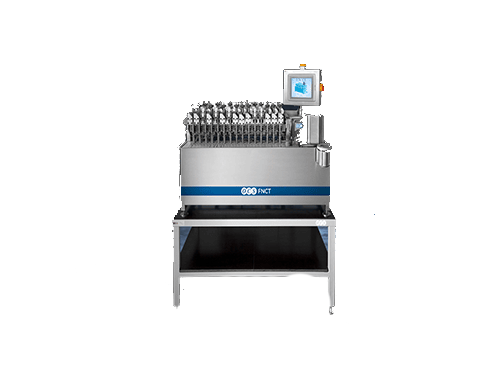
The OCS Full Notch Creep Test (FNCT) is a widely used method of classifying polyethylene materials in terms of their slow crack growth behaviour under accelerated conditions. A circumferentially notched body is loaded in a tempered wetting agent with a defined tensile stress, and the time until a break occurs is measured.
Features
 15 sample stations with independent tensile stress adjustment and data acquisition
 Load application through easily adjustable lever weight system
Precise adjustment of tensile stress through electronic force sensor
Uniform bath temperature control through extensive bath insulation
Exhaust air connections for targeted vapour extraction
Continuous pH value measurement with adjustable warning and alarm thresholds
No time limit on test times, time resolution: 1 second (real time)
Operation via touch panel with data trend as well as optical and acoustic alarm functions
High chemical resistance of the material used (stainless steel)
Specification
|
Tensile force range (infinitely variable pull arm system with 115–315 N) |
2.5–6.5 MPa for samples 10 × 10 × 100 mm with notch depth of 1.6 mm / 15–40 MPa for samples 6 × 6 × 90 mm with notch depth of 1.6 mm |
|
Force measurement |
Electronic force sensor with a resolution of 0.01 N |
|
Fluid volume |
Approx. 55 l |
|
Level control |
Stainless steel float sensors and magnetic valves |
|
Inlet pressure range for the supply of demineralised water |
0.2–8 bar (3–116 psi) |
|
Communication protocol |
MODBUS (RTU, TCP/IP), PROFIBUS, PROFINET, OPC (Server/Client), CSV file, customer-specific |